Hippo Chat

If you don’t know by now, I work at my local zoo with a variety of different species. One of which is the hippopotamus. One of our tasks as keepers is to give chats about our animals. Basically, you stand in front of your exhibit for about ten minutes talking about your animals. We give hippo chats and it’s something I’m getting trained on. Public speaking has never been my strong suit, and doing it while being watched by a senior member of our team makes it harder for me. So, since writing has always helped me, I figured I’d write up what I’d say at a chat. Some of it might be similar to my previous post about hippos, but you might learn something new.

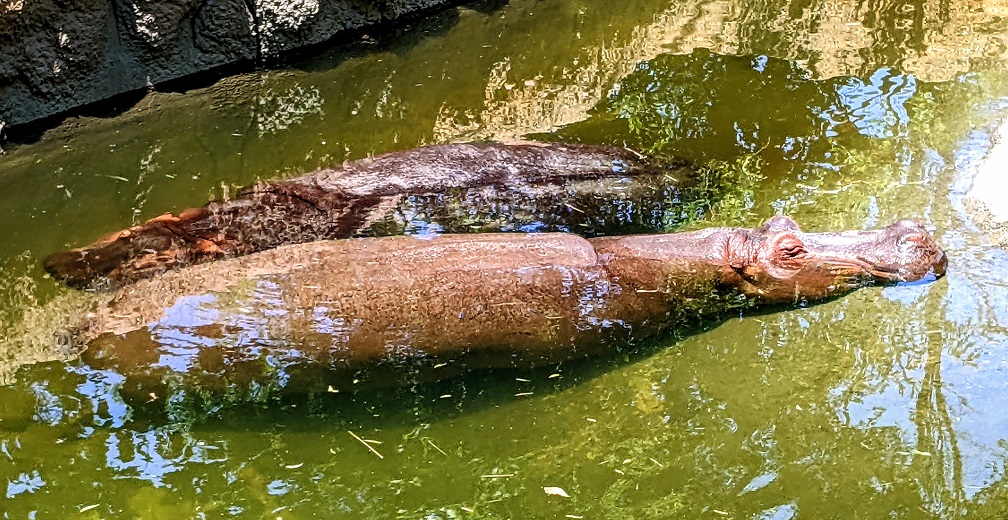
Good morning, everyone! My name is Nikki and if you’ll give me a few minutes, I’m going to talk about our hippos here at the zoo. We have two, female hippos. They are not related, but they are good friends. The largest of our hippos is 35 years old and our smaller hippo is only 6 years old. Hippos have a life expectancy of about 37 years out in the wild, but in captivity they can get into their fifties all because of the better care that they receive. They have access to medical care and their food is always provided.

Hippos are herbivores which means they only eat plant material. Out in the wild, they’ll browse grasses at night, but here at the zoo, we feed them hay, alfalfa, and a high fiber grain mix. We use fruits and vegetables as treats during chat time and training. Now, when it comes to our hippos, we are always in protected contact with them. We never enter their space and they never enter our space. We can touch them and feed them, but we’ll always have bars between us. Hippos are considered the most dangerous mammal in Africa. They are extremely territorial especially over their water source. If a person or animal comes too close, a hippo will open their mouth and display their incisors and canines as a warning. Hippos can open their mouths about 150 degrees. If a person or animal still comes closer, hippos will thrash their head back and forth to appear big and scary, and if that still doesn’t work, they’ll charge. Hippos can run up to 30 miles per hour on land for short bursts.

As I mentioned, hippos graze at night which means they’re mostly nocturnal and that’s because their skin doesn’t do the greatest in the hot, African sun. Hippos will spend about 16 hours a day sleeping in water. If they do come out on land during the day, they have a unique secretion called “blood sweat” that helps keep their skin from drying out, provides bug repellant, and antibiotics to heal wounds. Blood sweat isn’t blood, it’s just red in color.

Hippos can spend so much time in the water because they’re highly adapted to it. Their ears, eyes, and nose are all on the tops of their heads, so when they surface, they can hear, see, and scent all around them. Hippos don’t actually swim. They’re denser than water, so they sink to the bottom of the riverbeds where they live. They can hold their breath for about 5 minutes and when it comes time to breathe, they just push off the bottom of the riverbed to surface. Hippos can sleep underwater, their bodies naturally rise up to breath without them having to wake up for it.

I mentioned that hippos live in rivers. They can be found along the rivers and lakes in Africa. Their name: hippopotamus is actually Greek for “river horse.” Hippos got this comparison for how they walk along the bottoms of rivers, people thought they looked like horses trotting. Hippos living in the rivers of Africa is actually a good thing for the land. Their feces can float down stream and fertilize the land. They provide food for other species. Certain fish will eat algae and other built up off a hippo’s skin, providing hyenine for a good meal. There are bird species who eat the build up in a hippo’s mouth, providing good oral hygiene.

Hippos, themselves, don’t have any natural predators. Lions and crocodiles will go after baby hippos, but steer clear of adult hippos. Adult hippos are capable of crushing a crocodile in half with the force of their jaws. When it comes to social behaviors, hippos live in pods or bloats that are typically led by a dominate male. There can be up to thirty hippos in a pod. Younger hippos are kept in the center for their protection.

When it comes to endangerment status, hippos are not considered endangered, but their population sizes are being watched. I mentioned hippos graze at night. Well, sometimes, when they travel to graze, they end up in a farmer’s field. They can also find conflict with humans in the rivers themselves when boats try to pass through. Hippos are strong enough to capsize boats and can easily be mistaken as logs or stones in the water. Like most species, hippos are at risk of habitat loss with farmers encroaching on their grazing grounds and boats encroaching on their rivers. Ways to help hippos is to support your local zoo, part of your ticket purchase is going toward animal conservation. Other ways to help are to reduce, reuse, and recycle. Landfills take up a lot of space and the less we have in them, the fewer habitats they encroach on. Climate change can also effect the rainy seasons in African. A shorter rainy season leads to fewer grasses grown and can make it harder for a hippo to provide food. The rainy season is also their mating season and a shorter season will lead to less hippos being born in the wild.

Another way to help all sorts of animals around the world is through AmazonSmile. We all know of Amazon.com, the largest online shopping site that I know of. Well, smile.amazon.com is the exact same thing except part of the proceeds from your Amazon purchases goes to your charitable organization of choice. You could set your organization to the Cheetah Conservation Fund, Pandas International, Red Panda Network, tiger sanctuaries, Polar Bears International, elephant sanctuaries. You basically type in your favorite animal and you’ll find an organization dedicated to helping that animal. Then every purchase you make on Amazon will give a little bit of money to those organizations. So, be sure to double check your app and make sure you’re using AmazonSmile instead of just Amazon.com.

Okay. Does anyone have any questions about the hippos?
What’s Your Focus?

I would like to share a curious thought that I’ve been carrying for a while. It comes from last week. I had the opportunity to spend a couple days with my extended family at the lake. We had a lot of fun. Did a lot of swimming, played a lot of games, I got to water ski, and my uncle graciously paid for me to do a fun, fancy, monkey, jungle gym. Like I said: a lot of fun. But there’s one instance from my trip that I can’t stop thinking about and I’m going to do my best to explain why.

One of the days we were driving from my aunt’s and uncle’s place to my grandparents’ condo, we ended up passing several police cars on the side of the road. I believe there were three, because my uncle made a comment about their number. However, if he hadn’t made that comment, I wouldn’t have realized the police cars were there at all. I was staring right out the window where the police cars were, but I didn’t see them. Why? Because something else stole my focus.

Beyond the police cars, in this giant puddle, was a beautiful bald eagle. I rarely see bald eagles in the wild and they’re very important to my family. My late grandfather was a big fan of bald eagles, so whenever anyone from the family sees one, there’s always the comment of “Ope! Grandpa’s here with us!” I love bald eagles too. Birds of prey have always been majestic and graceful in my eyes. So, when I spotted that bald eagle behind the police cars that day, I couldn’t quite believe it. I kept staring at it like: “is that really a bald eagle? Is my mind playing tricks and its actually a turkey vulture?” Yet, the white head was as clear as day. The bald eagle just stood in that giant puddle with posture strong and head held high. I couldn’t tell you why it was there. Maybe it was bathing in that puddle, but by the time I thought to point it out to my family, we had already driven past. If I made a comment now, they could choose not to believe me or ask “well, why didn’t you point it out sooner?”

That got me wondering as to why they didn’t they see it? There was about seven of us in the car. If any member of my family saw it, they would’ve pointed it out (they’re far more versed with their voices than I am). I assume that after my uncle made the comment about the police cars, then they would’ve all turned their heads that direction. Though, I suppose their focus would’ve been on the police cars and why they were there. That could mean they were looking around for any wrecks or pulled over cars. So, they could’ve looked past them to see the eagle, but still no one called the eagle out. They could’ve not spoken up about the eagle–which seems very unlikely to me, but is possible. Or, none of them actually saw it.

I guess it all comes down to focus. What were we all focusing on in that moment? It was roughly a thirty minute drive. I don’t remember conversation at that point. I was staring out the window the entire time. I love to look at the scenery. The landscape is beautiful down at the lake. I love picking out the details of nature. That’s probably why I didn’t see the three police cars as we passed them. I was filtering out everything manmade. My family, on the other hand, is more curious about the manmade stuff than I am. They’re more likely to discuss what’s gonna go up in that empty lot, or that diner being shut down, and wonder how they’re going to reconstruct the roads this time, etc. etc. And like any honest person, they want to know what’s going on with flashing lights and they want to see how bad the wreck is when they drive by. Again, I have no idea why those three police cars were on the side of the road. My family could probably tell you, but as you know, I was quite oblivious to them. All I saw was that bald eagle.

That’s another curious thought to me and I think it can be applied in so many situations. Sirens and flashing lights usually indicate something bad has happened. They’re loud and they’re meant to grab your attention. You’re supposed to get out of their way when they come around, but for naturally curious human beings, they lead you to what went wrong. It could be something as simple as a speeder getting pulled over, or it could be something awful like a housefire or a pileup on the highway. Bottom line: flashing lights on a police car generally indicate something negative. In my experience, negativity has a rippling effect. You see a bad wreck on the side of the highway and that could stick with you. You could do the right thing and say a prayer for those involved, or you could find yourself condemning them by saying “they were probably speeding” like they somehow deserved it.

It’s hard to see beyond the bad when you’re so used to it. If you drive the highway a lot, you’re going to see a lot of wrecks. Even the News these days has a lot of terrible things in it: a murder, a burglary, a spreading disease, a bunch of government whatnot. It’s a lot of noise and flashing lights to steal your focus and dampen your day. It can make you feel like nothing good ever comes out of anything. Yet, if you dare to look beyond the noise and the lights, you just might see a bald eagle.

They say every cloud has a silver-lining. There’s hope at the bottom of Pandora’s box. Well, tragedies happen everyday, but I believe it’s possible to soar on wings like eagles right over them. You just have to take a good look around and ask yourself: What’s your focus?

Writer’s Getaway

Step out on a smooth deck, warmed by the sun
Breath in the fresh, lake air
The water glistens in the soft morning light
And a breeze teases the trees on the shore
Not a motion in sight in this peaceful lake life
The world wakes up slowly
You sit in your chair with coffee in hand
and smile at a tranquil land
The lapping of water and morning songbirds
Greet the rising sun
Lean back in your chair and prop up your feet
Have a notebook there in your lap
Within the peace, you welcome your dreams
Of story to put on the page
Away from bustle of city street life
Away from pressure and schemes
Take stories by the hand and write them again
On the deck of a lake in quiet and peace

On the Bookshelf

Here’s a question for you. What’s on your bookshelf? I mean, besides the books? If you just have books, what kind are they? Or maybe you don’t even have books on your bookshelf? What do you think what’s on your bookshelf says about you?

I have a tall and a short bookshelf in my room. The tall one holds all my books plus other things: there are dragons on the very top, my skull collection the next shelf down, then continues with old family antiques, my favorite childhood toys, and angel statues. All in all, I’ve got quite the hodgepodge of items on my bookshelf. It makes me think of that quote by Einstein that goes along the lines of “a cluttered desk is a cluttered mind.” Well, if a cluttered desk is a cluttered mind then what’s a cluttered bookshelf? Is it another peek into the mind, a window into the personality, or just some shelves holding antiques and text?

My second bookshelf contains some of my favorite movies, cases for my video games, and most of my notebooks. So, perhaps my bookshelves show a window into my personality or interests. Makes me wonder about people who have more than one bookshelf in their room/house. All the readers out there who have shelves and shelves of books they’ve read and books they want to read. Now that is a mind hungry for more.

So, what are your thoughts? Are bookshelves just bookshelves or do you think there’s more meaning behind them? Feel free to comment your ponderings here or on my Facebook and Twitter pages. What’s the world think about what’s on our bookshelves?

Water

Life’s description, liquid running cold water,
A wet field of play to splash away the day,
Cold running water

A source of energy a source of refreshment,
All life appreciates,
Cold running water

It crashes, it screams, racing to sea
In its depths brings the crushing darkness
Cold running water

To quench, to extinguish,
To destroy and drown
Cold running water.

This poem was created for a Creative Writing assignment called Mix Up Ghazal. I wish I could tell you the stipulations for it, but it was written November 2013, so I don’t remember.

“I Can’t Believe I Did That”

Have you ever made a simple mistake that you just can’t shake? One of those: “wow, I can’t believe I did that,” moments that takes residence in the back of your mind and won’t let you forget it? More likely than not, we’ve all been there.

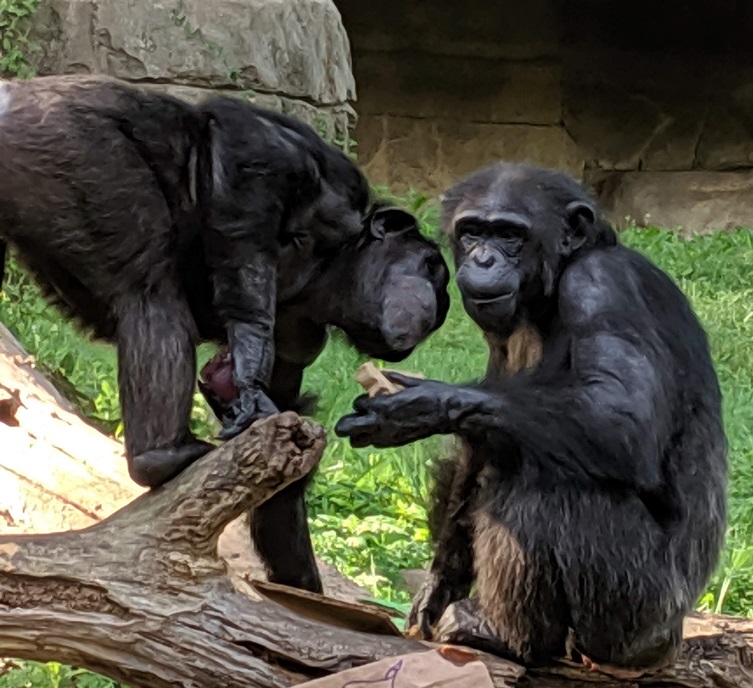
I work at a zoo and lately, I’ve been focusing on getting our individual chimpanzee identifications down. It’s going beyond the “well, that’s a chimpanzee” to “that one is Dave, there’s Millie, and the one over there is Monster.” Chimp IDs is being able to tell the chimps apart based on their individual traits: big ears, longer face, saggy swelling, grayer beard, scar on lip, etc. etc. etc. For two days, one of my mentors at the zoo had me ID the chimps several times (at least five) and I got them right every single time. Skip to the morning of the third day where our team lead has me ID the chimps and I manage to screw up on the very first chimp. I mistook this chimp for two others before I IDed her correctly. I know where I made my mistake. I was trying to do a quick ID without a clear head, so I just looked at just her face instead of her entire body. I can’t say if it was overconfidence that messed me up, the fact that it was early and I was tired, or the pressure of getting it right in front of the team lead, but after that mistake, I was doubting myself with all the other IDs and it showed.

I couldn’t stop kicking myself for over half the day. I messed up on one chimp. Just one and it wasn’t even the most difficult chimp to identify! I know these chimps. I know I know these chimps, but I jumped the gun on my identification. So, now it’s gonna take longer to prove I can do this.

Doesn’t it suck how a little mistake like that can dampen your day? It doesn’t have to be something like misidentifying chimps. It could be that you forgot something at home that you meant to bring to a party. It could be a question you missed on an exam or maybe you put something in the wrong place? Just a simple mistake that makes you think: “I should’ve known better. I should’ve done better.”

Mistakes like that will try to cling to you like burrs. If you get stuck on them for too long, they’ll start reminding you of other mistakes and other thoughts to further bring you down: “Ugh, I messed up on this one chimp just like I messed up on that one lock in 2019. Or that one question on my anatomy exam. Why can’t I ever get a 100%? Why do I always mess up when it counts? What am I gonna mess up on next?” Thoughts like that can be a rampaging stampede if you don’t wrangle them in at the gate.

Makes you wonder why it’s so hard to move on from simple mistakes. I’ve been told human beings strive for perfect, but can’t ever achieve it. With that in mind, it must take a special kind of discipline–or confidence–to just shrug and say: “yeah, I missed a chimp, but I know why. I’ll do better next time.” Some people have a more defined discipline for that kind of thing. I struggled with making my mistake for half a day while my coworker shrugged off hers in two seconds.

Regardless, we’ve all made mistakes. I’m certainly going to do better with my chimp IDs and not rush the answer until I’m confident in who I’m seeing. It’s easy to beat yourself up over your mistakes and start second guessing your actions, but that’s no way to live. You’re going to make mistakes every single day whether you realize it or not. Instead of going insane by trying to carry every mistake with you, take a deep breath, acknowledge it, admit to it, figure out what you did wrong and how to do better, then move on. You learn more with every mistake than you would if you got everything right all the time.

I hope you keep all this in mind the next time you find yourself saying: “I can’t believe I did that.”

Picture of You

I’m an artist. Those of you who follow my blog, you know this. I don’t sell any of my work, but I do like to display it. My bedroom walls are covered with artwork that I’ve done whether drawn with pencil, pieced together with paper, done with pastel, or built from wood. I’ve even started filling up the walls in a separate room with my paintings. It’s enjoyable for me to be able to sit at my desk and look around the room at the artwork I’ve done. Each one has a story. Each one has a purpose: whether it involves my novel or was my best artwork in high school.

This leads me to the picture featured in this blog post. It’s sort of a random drawing if you think of it, but it was done with drawing pencils, black pens, and ink. It’s a drawing my from college days. I took a class and the assignment was to “play” with shading and how different black and white media stands out against each other. The assignment could not be done all in one day. We were given a time period (I don’t remember how long) and we had to add just a couple items in the picture at a time. It could be something that was on our mind or something we saw, but it had to pertain to us in some way. Then, we had to connect everything together by stringing something across the page.

In a sense, this assignment was to create a picture of you without drawing your physical appearance. I remember the day mine was critiqued in front of the class. It was one of the more favored drawings that day. Everyone liked how the longer they looked at it, the more they saw. From the small details in the cheetah’s face to the notes of my high school theme song hiding on the side of the page. I tried stringing everything together by my favorite Bible verses: the Armor of God. In my opinion, I did a terrible job at it, but it just goes to show that nobody’s perfect.

This drawing was done in the year 2014. It’s the only drawing my college days that made it on the wall of my room. Not because it was the best, but because it felt the most like me. If I were to repeat the assignment, I probably wouldn’t put the same things on it. I’m still a Christian, still love cheetahs, the moon, Legend of Zelda, and Pokemon, so those items would still find its way on there, but the caged bird would probably be freed, the SmashBros. symbol would disappear, and the chains would be taken off. I’d probably add more animal species that I’ve worked with and the symbol I use for my novel would be one of the most prominent things on there. It’s a good reminder of growth and what I enjoyed then verses now. Granted, not a lot of things would change, but I would do quite a bit of it differently today.

So, what about you? What would be on your picture of you? Animals? Games? Symbols from books, movies, TV shows, companies, some abstract art that defines you? And how would you string it all together? It doesn’t have to be brought together by words, it could bubbles, or snakes, or lightsabers, whatever is you! I dare you to give this exercise a shot. Take a piece of paper and draw something new on it every day. Use different media so that some details hide in the background and others are more prominent. Make it the picture of you.

Take a Deep Breath

Take a deep breath
You’re doing great
No one can say you’re an honest mistake

You try so hard
To chase a dream
And when you fail
you’re the only one who’s mean

Beat yourself up over an easy undo
Because you have everything to prove
And if you’re not perfect, you think you lose
You think everyone will disapprove

A mistake swarms your mind
One that’s easy to mend
But from it, you know you’re out of time
You fear this is the end

But forget the stress
Chase your dreams
You’re doing your best
Forget anxiety’s schemes

You’re doing great.
You put in the work.
Don’t worry about proving your worth.

So, take a deep breath
Remember, you’re okay
It doesn’t mean death
If you find yourself astray

Keep trying and glow
Make your difference
Surely you know
You can go the distance

Don’t beat yourself up
Don’t think your corrupt

Just take a deep breath
You’re doing great
Remember, you’re not a mistake

Bathroom Heroes

Writing Prompt: Name three things in your bathroom right now.

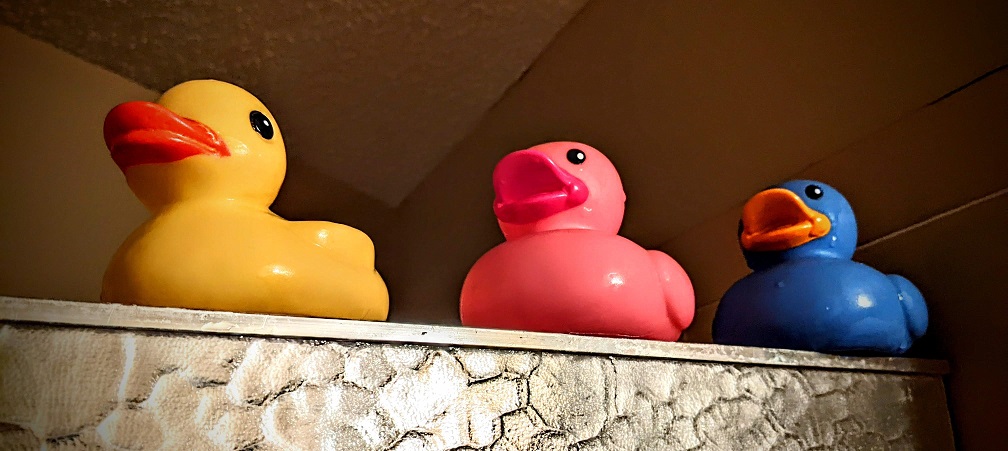
On the rim of the shower, three brave heroes watch over those who enter the Room of the Bath. When the darkness of lowly thoughts assault privacy, our heroes stand to deflect it with light. No judgement is cast from our heroes and they take their job with pride!

Lucky, the Yellow Rubber Duck, stands as the leader of our valiant trio. He is quick! He is observant! And, he is thoughtful in his decisions. Lucky has the power of sunshine! His brilliant light is warm and banishes the shadows of darkness! None need to fear the cold when Lucky is in the room!

Up-beat, bubbly, and dangerously chatty, the second member of our trio is Pinky, the Pink Rubber Duck! She always has an encouraging word on her tongue and can even talk the shampoo off the shelf! Pinky will happily talk out your problems and give you the strength to fight your own battles of the mind. If ever you need a friend, Pinky is the one to call.

The final, but never the last, member of our trio is Blueberry, the Blue Rubber Duck and older brother to Pinky. Blueberry’s chill vibes bring a sense of calm to the air. He is the best swimmer on the team and its speculated he can control the water itself! Blueberry is the best buddy to float the river with. Not even shadows can stress him out! He’s the chill-est of all dudes!

Honor to you noble ducks for battling the distress of the mind with your bright colors! All who may enter the Room of the Bath need not fear the shallows of loneliness or the grays of the mundane. Keep on fighting and never lose your courage! Your service is never in vane and our gratitude never expressed enough!

Painted Identifiers

Currently, I’m a seasonal keeper at my local zoo and it’s given me the amazing opportunity to learn a lot about different animals. One thing that I absolutely love about animals is that a certain species may all look alike, but they’re all different. They’re all individuals like us humans. We all share the same relative shape, but some of us may have high cheekbones, or brown hair, or be shorter, or longer limbed, etc. Etc. Etc. The same goes for animals. At my zoo, I’m learning how to distinguish the animals we care for. Learning to catch those differences that set them apart from each other. This week, I’ve been working on distinguishing our African Painted Dogs.

African Painted Dogs are the “wolves of Africa” and have the most successful hunting rate in Africa. They believe in cooperation and even have altruistic values in taking care of the old and sick in their pack. Most people mistake them for hyenas, but fun fact: African Painted Dogs are more closely related to dogs while hyenas are more closely related to cats. The way we tell our dogs apart is by their painted pattern.

African Painted Dogs have three colors on their coats: black, white, and orange. When they’re born, they’re born black and white and the orange fades in as they grow from some of their black patches. We tell our dogs apart by who has the most black, most white, and most orange, and if we can’t tell by that, then we pick out distinguished markings in their coat or notches in their ear. Distinguished markings could be a white patch with a black spot in it or stripes of white down their side. It could also be the way their fur lays on their face: a more distinguished squiggle in the black stripe on their forehead or maybe their cheeks aren’t as orange as other dogs.

Now, painted dogs in the wild aren’t going to line up for you to catch the uniqueness of their coats, but at the zoo, we can line them up for training or they’ll patrol their exhibit in a perfect “follow the leader” situation. Other times, they’ll bunch up and you’ll just have to get lucky, but as with any animal, the longer you’re around them, the more you’ll get to know them and catch those fine details with just one glance. That’s what I’m hoping for with our Painted Dogs.

So, the next time you go to the zoo, I’d like to encourage you to look for those unique markings on the different animals. If your zoo doesn’t have Painted Dogs, try it with the chimps. Take a good look at their faces to see those distinguished features. I believe you’ll gain a better appreciation for the species if you do.