Aching Dreams

Have you ever wanted something so badly it hurt? Maybe not something like a piece of pie sitting on the counter, but a goal or a dream? Have you ever had a moment where you see someone living your dream and you just feel an ache because you want that too? I can list off several times I felt that. Whenever I see someone releasing a new book, as excited as I am for them, it nags at my desire to get my own published. And there was my time volunteering at the zoo a few years back. I’d help with cheetah enrichment and talk to the cheetah keeper. I remember thinking how much I wanted her job.

Perhaps that ache you feel is the “thou shalt not covet thy neighbor” warning we hear growing up. Or, perhaps that ache is a guide, letting you know where your path will lead. What goal you should shoot for. But, you have to be careful. As much as that ache can help push you toward your dreams, you can’t let it push you toward bitterness. As much as I want my novel published, I’m not going to be bitter and angry with all the people already achieving that dream. I’m going to celebrate with them and let their success inspire my hope that one day my novel will be sitting on the shelf next to theirs.

Same goes for the cheetah keeper. I’m not going to begrudgingly follow her around because she has the position I want. I’m going to learn from her. Get her insight into the position and what skills I can improve to help me get to her point.

I guess what I’m saying is that you shouldn’t tear others down for achieving a dream you’re also pursuing. Don’t let bitterness creep in and ask the question of “why them and not me?” but let hope inspire by saying “Yay for them! Next is me.”

So, what dreams are you pursuing that make your heart ache because you want them so badly? How are you pursuing them? How are you letting that ache guide you?

Communication Dies

It festers in the ground
A word here
A whisper there
Who knows if its true
Or if its a lie
But it’s enough to make families die
A bond so strong
Cousins, friends, or coworkers
A rumor comes out to commit murder
Lies. Deceit. Your own fabrications
Bitterness and grudges. No communication
No hearing the story
No seeking the truth
No understanding one another so we might make it through
Through all the pain
Through all the falsity
Through the fakes and gossip
And the misread hostility
“Let it go”
“Move on”
“Just forget it”
But still it lingers for you to regret it
Someone remembers
Someone can’t forget
Someone there can’t let go yet
They’ve decided their trust was regrettably misplaced
They’ve decided their efforts were all a waste
Trust not the one who believes they did no wrong
Trust not the one who makes you feel you don’t belong
A simple mistake could be easily fixed
If ears were open and all hearts were selfless
But the rumors have spread there in the dark
Not everyone sees them. Not everyone’s a part
Of the gossip, the judgement, the envy, and grudges
The Darkness that corrupts everything it touches
Now a bond once so strong is now bitter and weak
To the point where some simply refuse to speak
Pride slips in. “It’s not my fault”
You close yourself in just like a vault
“They’re the one who brought this on themselves”
“They’re the one sitting upon their shelf”
“Looking down on the others in our tree”
“Thinking they’re somehow better than me.”
The lies sneak in. You eat them right up
And everyone else decides to just give up
Then the distance sets in
And time is to blame
“I’m simply too busy to call out their name”
“Communication, anyway, is a two way street”
Both parties think that, so they’re both in defeat
A bond once had, now destroyed by lies
This is what happens when communication dies

Winning Pitch

This year, it’s my goal to pitch and query my novel to literary agents. This is a skill I’m still developing, so I’ve been reflecting on my notes from previous writing workshops to help me craft the best kind. I thought I’d share some with you today.

Back in 2020, one of the classes I took at a writing workshop focused on pitching. When you pitch your novel, you’re trying to get someone (literary agents, editor, publisher) interested in it. Pitching is super stressful. You need to sum up however long your novel is (in my case 100,000 words), in a few short sentences. It needs to be enticing. You can throw out a quick summary, but if it isn’t engaging, whoever your pitching to isn’t going to swing.

According to the workshop I attended, you want the focus on your pitch to be on your main character. What are their goals? Intentions? Wants or desires? When you think about it, readers are going to be spending hours with your main character when they read your book. So, why should they want to?

For elevator pitches–pitches short enough to entice someone on an elevator ride–you don’t want to waste time on character names. Instead, you should focus on description:
“Girl wanting to be seen as herself…”
“Princess desiring peace…”
“A peasant’s son hoping to be someone…”

With the desire of your main character in place, focus on description. More adjectives add to setting, character, genre, and plot. You need to be judicious. Be specific and as unique as possible without using words from story that people won’t understand. By that, I mean anything in your world that you would have to explain to someone. If you made up a race of people called Vamato, you don’t have time in your elevator pitch to explain that the Vamato are vampire tomatoes with green skin. With descriptions, your pitch evolves:
“The daughter of a wealthy scientist wants to be seen as herself…”
“A crippled princess desiring world peace…”
“The son of an alchemist wants to prove to his father he isn’t useless…”

Then, you want to introduce your main conflict. Who’s the antagonist or the antagonistic situation? How are they keeping your main character from achieving their dream?
“Daughter of a wealthy scientist wants to be seen as herself, but she dies and her spirit is engineered by a techno-cult as a living host.”
“A crippled princess desiring world peace must face a prince of an invading country in one on one combat.”
“The son of an alchemist wants to prove to his father he isn’t useless. He joins the King’s Army, and gets his chance when tasked to find an ancient legend.”

Next is the plot synopsis. What makes your story unique? Show the world its set in.
“Daughter of the scientist meets polar opposite, key to immortality.”
“Crippled princess from an underground colony.”
“An alchemist’s son is tasked to uncover an ancient legend that may not exist.”

The most important thing you can put in your pitch is the emotional hook. Why should the reader be interested in your main character?
“Daughter of a scientist dies trying to get her father’s attention…”
“Crippled princess must face childhood love in combat…”
“Son of an alchemist loses his best friend in their dreams to prove their worth…”

Finally, you need your stakes. What will happen if your main character DOESN’T get what they want?
“If the daughter is captured, cult will make an army of shifters capable of taking over everyone.”
“Crippled princess’s people will rot in the sun.”
“Alchemist’s son must race against monsters to find an ancient legend else the kingdom will fall under Darkness.”

Good thing to remember is that tension and urgency keep people reading. Whenever you’re pitching in person, you want to talk about your book like you were talking to your friend. You LOVE your book. Tell the person why so they can love it too.

There is an easy way out with pitching if you can’t decide the best way to pitch your story and you find yourself in an spur the moment pitch session. You can always use this formula:

“When [inciting incident] occurs, [main character] must [objective] or else [stakes].”

Now, I have to be honest. The first two of the examples I used when going through the pitching elements were taken directly from the Writing Workshop I attended. The third was me experimenting pitching with my novel. As you can see, it’s not as exciting as the other two. When you throw it all together, this is what you get:


“The son of an alchemist wants to prove to his father he isn’t useless. He joins the King’s Army, and gets his chance when tasked to find an ancient legend that may or may not exist. With a dark mage hunting for it as well, the alchemist’s son must get it first or Darkness will corrupt hate and fear throughout the kingdom.”

Not bad, in my opinion, but it could be better. I’ll keep researching pitching and querying and share my findings with you guys. That way, we can grow in this skill together.

I wish I could tell you who gave the class at this writing workshop from 2020, but I didn’t write down their name. For information on how to sign up for upcoming Writing Day Workshops (both online and in person), follow this link: Writing Day Workshops.

You Gotta Believe Me

Write about a time when no one believed you.

The first thing that comes to mind when I read this prompt is high school, senior year. Us seniors were a part of a class wide English game involving the novel Nineteen Eighty-Four by George Orwell. It’s a popular dystopian novel. Most of us had to read it in school. It’s where the phrase “Big Brother is watching you” came from as the population in the novel is constantly controlled through surveillance. Personally, it wasn’t my cup of tea, but I did enjoy the game my senior class had to do because of it.

In the book, there are these people called Thought Police. They’re normal members of society who make sure everyone else is following the rules of society. Your neighbor could be one. Your family member or co-worker. If they caught you breaking a rule, they turned you in, and you faced punishment. My senior class did something very similar so we’d understand the kind of world in Nineteen Eighty-Four. We had rules we had to follow and here were a few of them:

  • Don’t talk about the game to anyone–ESPECIALLY UNDERCLASSMEN. If asked about the game, say a specific phrase that I no longer remember.
  • Greet your teachers by saying: “I am eager to learn today.”
  • No chewing gum or eating during class.
  • No looking at your phone during school hours.
  • No passing notes in class.
  • No having earbuds in during school hours.
  • No talking during class unless called upon by a teacher.
  • Don’t be tardy or absent.

The game lasted for about a week and at the end of it, we may have had to write an essay. Here’s the kicker. The word count for the essay started at 500 words–no big deal. However, if you got caught breaking a rule by the Thought Police, 500 more words would be added to your essay. 500 for every rule you broke. Pretty sure some of my classmates got up to 10,000 words. There was a way out, though. By the end of the week, if you could correctly identify a Thought Police, you didn’t have to write the essay at all.

So who were the Thought Police? They were other members of my senior class. My fellow students, and you know what? I was one of them.

I was a Thought Police. The very first day the game started, I got the email. To be a Thought Police and stay a Thought Police, you had to turn in at least five rule breakers each night. I didn’t like it. I didn’t like the idea of turning my friends in for silly rules. I’m a loyal person, not a snitch. The idea of turning my friends in and increasing their essay word count felt like betrayal to me. I wanted to decline. I didn’t want to be viewed as the ‘bad’ Thought Police, but then I realized something. If I became a Thought Police, then there would be one less for my friends to worry about. If I declined, the job would go to someone who would likely be more than happy writing me and my friends up for breaking the rules. So, I accepted with the vow that I wouldn’t rat out anyone I considered a friend.

Yet, I had to be careful. I couldn’t let anyone know I was a Thought Police else I would have to write the essay. Thought Police had different rules from normal students. If you got outed, you wrote the essay with the word count to however many rules you broke. If no one pegs you as a Thought Police, you’re off the hook. You write nothing. I remember the day before the game started. My classmates were either hoping to become Thought Police-or making alliances to out the Thought Police. No one wanted to write the essay no matter how long their word count was. I knew when I became a Thought Police I had to be EXTREMELY careful.

I lost count of how many times I lied to my best friends about being a Thought Police. I remember being in my history class with two of my animal science friends. We agreed we would look out for each other. We’d be the three musketeers against the Thought Police. Help each other out them so we wouldn’t have to write the essay. I felt terrible. Here I was, a wolf among sheep. Neither of them suspected me. They broke rules right in front of me, and it was my obligation as a Thought Police to turn them in. But, they were my friends. I took the job to protect them.

I wish I could say I soared through that week without anyone realizing I was a Thought Police, but one of my friends did figure it out. He cheated, really. We were outside of school, in church, and he asked me. Of course, you can’t lie in church, so I had to tell him the truth. Thankfully, he promised not to out me as long as I racked up the essay word count on a different student. That other student was a bit of a bully to my friend, so I obliged.

Throughout the week, more Thought Police were added to up the stakes. The list of rule breakers grew over a page each day. One of my best friends came to me in English class a few days into the game and admitted she became a Thought Police the night before. She said she had no intention of writing me or our other friends up for breaking the rules, but she wanted me to help keep an eye out for other rule breakers. I could’ve admitted my guilt to her. Told her I was a Thought Police too since she was trusting me with the knowledge of her being one, but I didn’t. I played the part of an innocent non-Thought Police because I didn’t want to be overhead by potential eavesdroppers. My friend bought it, and I informed her of all the students I saw breaking rules. Students I turned in as well. Students that were not my friends.

It was a fun week, playing Thought Police, but I remember being thankful when it was over. No more lying, no more sneaking about, and no more trying not to get caught breaking rules. I remember when the list finally went up outing all the Thought Police. I lost count of how many of my friends and fellow students got mad at me seeing my name up there. No one had a clue I was a Thought Police. Which meant no one turned me in so I didn’t have to write the essay (and my word count definitely reached over 3000).

As good as it felt to get away with being a Thought Police, it bugged me when my friends didn’t believe why I did it. I told them I did it for their sake. I didn’t write any of them up, but I got a lot of doubt in return. I then, found out one of my close friends was also a Thought Police. I had broken a rule right in front of her and she wrote me up for it. If she was willing to do that to me, then others believed I would do it too. I’ll admit I was hurt. The loyalty I felt toward my friends didn’t quite go both ways, but I wouldn’t change how I handled that week. I got away with being a Thought Police and I stayed true to my friends. That’s a victory in my eyes.

Hard to believe it’s been over ten years since then. It makes me think of all those stories where someone plays the bad guy for the sake of good. You see it in Star Wars, in Harry Potter, and much more. Those characters always get a bad rap. Their friends and family hate them because they “betrayed” them, when in reality, they did it for them. I got a little taste of it with our Nineteen Eighty-Four game.

That’s what I think of when I recall a time no one believed me. What about you?

Tribute to Songs

Owed to the boat built in sand, believing for rain
To the ones who touched and went their separate ways
To the one saying “Hello Darkness, my old friend.”
And those dubbed Unforgiven
To the reminder to serve while in the waiting
Knowing I just haven’t seen it yet.
To little miss one big mess and never rest
And the ones asking why you’re so mean
To the one who feels like a Monster
And the one falling through the black
To the one who just needs a reason
To finally come back
To the group who’s not going to die
Because it’s too good to be alive
To the ones in shame
Never to be called babe
And the ones accidentally falling in love
To the Renegade, running away
And the one who wants to be known for centuries
To the one at the mirror, asking who’s the loneliest
And the warrior who only wants what’s just
And most importantly to the Unstoppable One
Making a way
And let me just be proud to say
To my main character, he’s mine. That one
Got a wild-hair side and handsome
He’s fooling himself and he doesn’t believe it
But he’s got everything he needs to achieve it
And we wait, serve, and believe
For our dreams to finally be achieved

Admirable Qualities

Question for you, and I’m sure everyone’s answer will be a little different:

What is a personality trait you admire in other people?

There’s a lot of personality traits out there: patient, geeky, listener, football fan, kind, thoughtful, funny, and so on and so forth. When you think about your closest friends and family. What is the trait that you think of first that you like about them? Is it knowing that they always have your back? They’re the shoulder you need to cry on? Or is it that they’re your partner in crime? A mentor? A role-model? If someone comes to mind, maybe you should tell them? Make their day. Just say: “Hey, you know, I really like this about you,” and watch them smile. Maybe you’ll get a compliment back?

But, stepping back. Let’s look at people as a whole. Go back to the basic traits of loyalty, patience, honesty, and whatnot. What is the first trait that comes to you mind that you admire about others? You want to know what mine was?

Boldness.

I admire boldness in other people. I admire those people who can just say whatever they want and not feel ashamed for it. I admire those that believe in themselves and don’t doubt their abilities. The ones who aren’t afraid to stand up or speak out for what they believe in, what ideas they have, and their worth.

Yes. Let’s get shrinky. I probably admire that trait so much because I lack it. I’m not someone who cuts someone off when they’re speaking. I can’t speak up in a crowded room or a team meeting. I worry too much about sounding dumb. I wish I’m more confident than I am. But, I love seeing others speak their mind. Doing what I can’t do. Telling a funny story without shame. It makes me wonder if there are others out there like me. I mean, does a hothead admire patience because they lack it? Does liar admire honesty because they fight their own tongue? Does a chatty person admire listeners because they have a hard time listening themselves?

What do you think? Feel free to share your thoughts. How would you answer the question? What admirable traits do you admire in others?

Red Ruffed Lemurs

In the northeastern forests of Madagascar live in the Red Ruffed Lemurs. These incredible animals primarily live in the tree canopy. The eat fruit and nectar, and act as important pollinators to their habitat. Red Ruffled lemurs live in social groups known as troops. Troops can vary in size and have subgroups spread throughout their territory. They can have up to six infants per litter and the troop practices communal care where everyone is involved in raising the young. They reach maturity around two years of age.

Because red ruffed lemurs live in such a small area of Madagascar, they are considered critically endangered. They’re victims of pet and animal trade, habitat loss, and hunting. Their natural predators include hawks, boa constrictors, and fossae. Yet, like any other species, humans are their greatest threat.

Some fun facts about our cute, little lemur friends:

  • Red Ruffed Lemurs love to sunbathe. They’ll sit back on their haunches and open their arms to sun to warm their black belly fur. This behavior was misinterpreted by early natives of Madagascar as sun worshiping. This mistaken belief helped protect the species for a time.
  • Like other primates, lemurs use their tails for balance when leaping through the trees. They also use their tails to signal and communicate with each other.
  • They have well developed smell, vision, and hearing. Red Ruffed Lemurs are able to identify each other by scent glands found on their rumps.
  • Red Ruffed Lemurs have very loud calls that can be heard for miles around. These calls alert of threats and warn other lemurs not to encroach on their territories. At my zoo, you can hear our lemurs from the complete far side of our African section.
  • Best way to tell Red Ruffed Lemurs apart is by using the white patches on their feet.
  • The lemurs at my zoo love grapes, bananas, and sweet potatoes. While on exhibit, they like to sit in the sun and receive armpit scratches.

Belittling Frustration

You know what’s frustrating? I’m not a confrontational person. I avoid conflict like the plague. I’m also a sensitive person. I cry easily and when I cry, I lose my voice, and I hate it. I hate being so sensitive. But, being a sensitive person, I can usually tell what someone else is feeling. Get an air about them as they enter a room. So, as a sensitive person who hates conflict, when someone approaches me with the clear signs that something’s wrong (their posture is stiff, they’re facing directly at me, their tone is guarded, and their eyes tell all). When they approach with this stance, I want to go away. I know right off the bat this won’t be a pleasant conversation so I don’t want to be a part of it.

Yet, I’m also someone who addresses those that want to talk to me.

When someone approaches to admit their beef–or rather NOT admit their beef, but judge me for it anyway–I have to fight through my inner panic to give a response. Let me tell you, I never come up with the best thing to say. My responses likely makes me seem dumber than I actually am, but there’s a reason for that. I’m not a talker. I’m a WRITER. I can’t think of the perfect words on the spot. I need time to mull them over. When you’re in a confrontational conversation, whoever’s approaching you wants answers immediately. They don’t want you to think about it. They want you to crack under their scrutinizing gaze and prove them right. The most frustrating part about this is the aftermath. After they’ve taken their victory and left. It’s in the aftermath that I think of the perfect words I should’ve said. It’s in the aftermath that my mind has the conversation that would’ve made me proud of myself.

It’s in the aftermath that the pen comes out.

Writing is sometimes the only way for me to get over something. To focus my thoughts and clear my head. Get it on the page and let the page carry the burden. After that, I can usually walk away from it. Get some sleep. Move on.

Maybe you’re like me? Sensitive. Nonconfrontational. Frustrated. If you haven’t tried writing to help you through it, I recommend it. Just know you’re not alone. I wish I had the answer to help deal with those confrontational conversations. The answer on how to be bolder and stand up yourself whenever someone is belittling you. But I don’t.

What I can tell you is that you need to move on. What happened, happened. You can’t change it. You could try to approach the person and set things right, but they might not be in the mindset to see things your way. They might not even realize they were in the wrong. So, don’t sweat over it. I was belittled recently and it stuck with me for days afterwards. In the end, there’s nothing I can do to change what happened. I can only change what I do now and I choose to not let it bother me. I choose to not think about it. Not dwell on it or let it define my decisions moving forward. Someone belittled me. It probably came from a place of hurt and misunderstanding. I’ll give them that benefit of the doubt. Why should I sink down to their level and hold a grudge? Grudges only hurt the people who hold them. So, I’m letting it go.

Yes. What they did hurt me. Their actions in a span of a few seconds affected me for days, but I forgive them. I’m letting it go and moving on because it’s not worth it. I’m worth more than how they made me feel, and I don’t deserve to have this dragging me down.

I hope you’ll see things this way when someone belittles you. Don’t let others drag you down. You’re worth more.

A Gift From an Artist

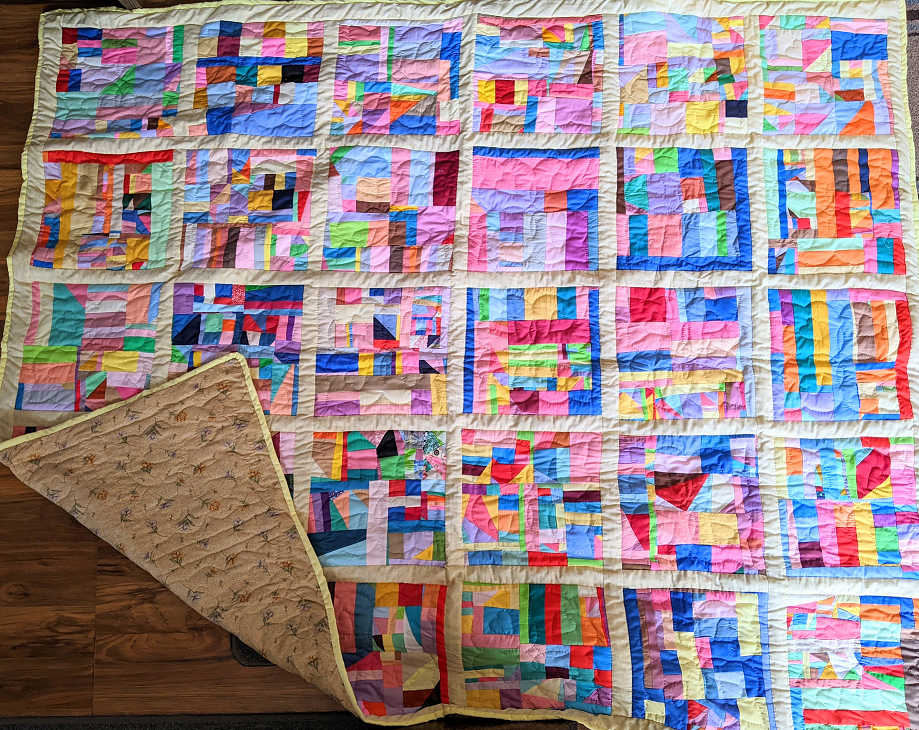
Have you ever received a gift from an artist? What was it? How did you react? I received a beautiful gift from an artist recently, and as an artist, I like to give my art out as gifts. So, what’s the best way to receive these artful gifts?

If you ask me. The best way to receive a gift from an artist is to appreciate it. REALLY appreciate it. Don’t just say “wow, that’s beautiful” and move on. Say “wow, that’s beautiful,” and admire its beauty. Take a moment to really look at the strokes involved in the artwork, the pattern of the stitches, or the blend of the colors. Look for the shapes within the patchwork, and hear the story behind it.

Now, you do have to be careful. Taking the time to admire the beauty of the art also gives you a chance to find its flaws. Artists are human, we’re not perfect. You may find a hair in the painting or a loose thread in the stitching. Spacing might be off, or details might not be fine enough. When you come to these flaws, the best thing you can do is to NOT MENTION THEM. What you’re receiving is a gift. The artist worked hard to make it for you. They spent their time for you. They didn’t make it so you can critique it. They made it so you can enjoy it. So, why bring them down by pointing out the flaws in their hard work? The best thing you can do as a gift receivers is to make the giver feel good about giving the gift.

Now, I get it. There are people out there who aren’t artists. The best thing you can draw is a stick figure. So, when an artist gives you an incredible piece of work, you compare it to your own abilities and it makes you feel a tinge of jealousy or inadequacy. I certainly feel that way when my art is compared to others. These feelings of jealousy or wishing you were a better artist then you are tend to lead you into looking for the flaws in the artwork you’ve received as a gift. You point out the flaws because it makes you feel better. Tells you that this artist who gave you this incredible gift isn’t perfect. Well, it might make you feel better, but it doesn’t make the artist feel very good. They worked hard to make this for you, so don’t point out any of its flaws. Keep those flaws to yourself and appreciate the gift. I mean, that’s our job as gift receivers, isn’t it? Someone takes the time, money, and thought to give us something, we should make the giver feel good about giving it out. People say that it’s better to give than to receive, but how people receive may ruin someone’s desire to give. So, it’s equally as important to know how to receive any gift, not just artwork.

I hope you’ll keep this in mind whenever you receive a gift. May you receive it with appreciation and keep its flaws to yourself. You don’t want to be that person nobody gives anything to because you always find what’s wrong with it.

2023 Dreams

Hey everyone! Haven’t seen you since last year! Can you believe it? I haven’t posted for you guys since last year.

Those are the kind of jokes we all hear at this time, aren’t they? They’re certainly going around my DnD group. I’ll admit it. I find them amusing, and do them a lot.

But, in all seriousness, it’s 2023. How are you feeling about it? Excited? Nervous? Dreading?

If you ask me, I’m hopeful. 2022 was good to me. I’m hoping more dreams will come true in 2023. I’m hoping I’m brave enough to seize them with both hands.

I’ve made my dreams pretty clear in previous posts. So, what about you? What are your dreams for 2023. How are you going to help them come true?

Feel free to let me know in the comments here or on any of my social pages.

Cheers to 2023, everyone. May all our dreams come true.